

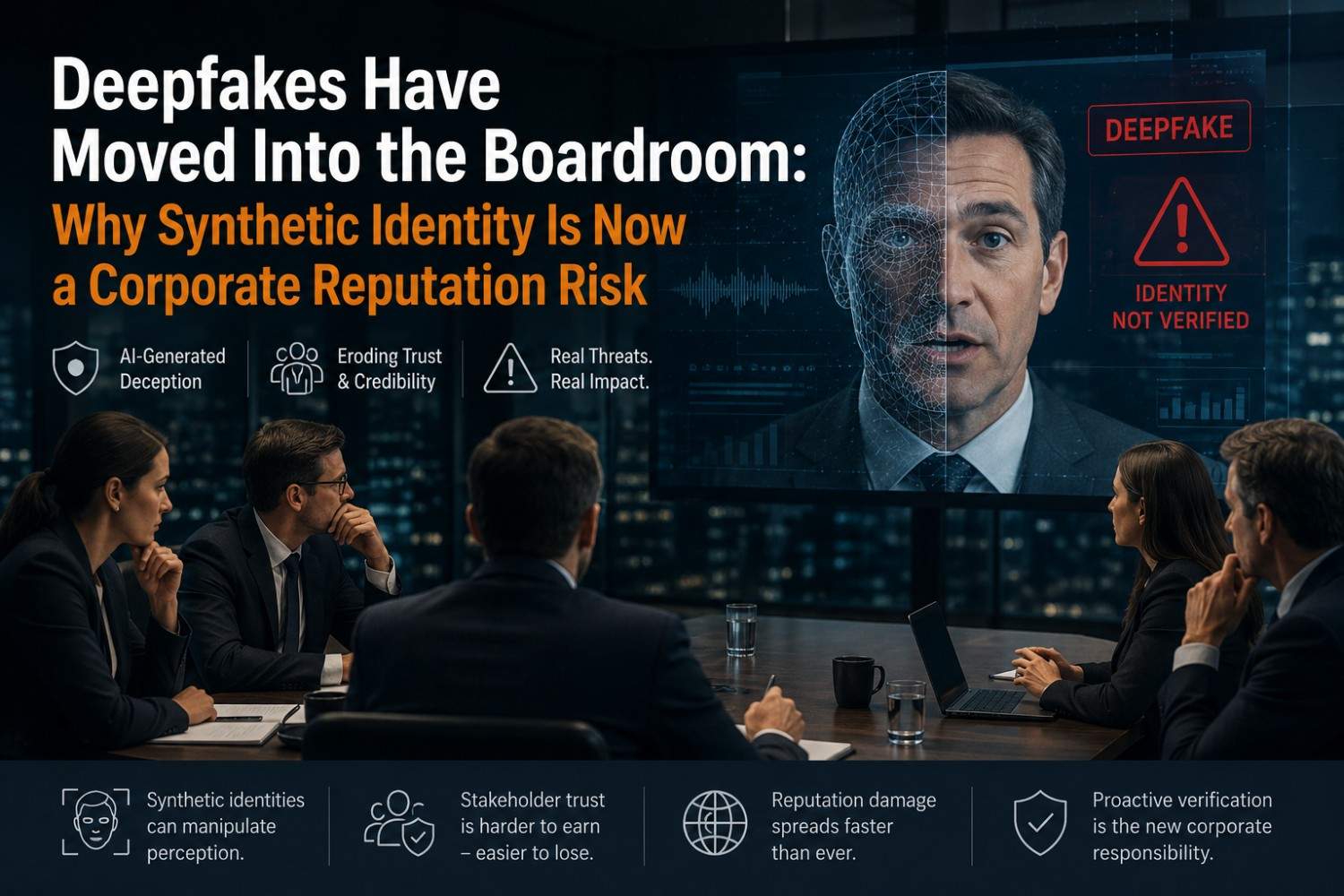
Why deepfake reputation risk now belongs in the boardroom
Deepfakes have crossed an important
threshold. They are no longer primarily a celebrity, entertainment or political
misinformation issue. They are becoming an enterprise risk because a trusted
face or voice can now be converted into a convincing instruction, endorsement,
confession or announcement at very low cost.
The reputation damage does not
begin when the organisation confirms that a video is fake. It begins when a
stakeholder acts on it. An employee may transfer money. An investor may sell. A
patient may trust a false medical claim. A journalist may seek urgent comment
on a fabricated statement. A regulator may ask why a misleading endorsement
remained visible. By the time forensic verification is complete, the content
may have moved through closed messaging groups, regional-language pages and
copied advertisements that are difficult to trace.
Recent Indian court action has
sharpened the legal signal. The Bombay High Court granted interim protection to
Preity Zinta against alleged misuse of her identity through AI-generated
deepfakes and morphed content. The Delhi High Court protected Ravi Kishan’s
name, image, likeness and voice, including against AI-generated and deepfake
exploitation. These cases involve public figures, but the operating lesson
applies to any recognisable corporate spokesperson: identity is both an asset
and an attack surface.
The legal environment is moving faster than most crisis manuals
India’s 2026 amendments to the
Information Technology Rules introduced a specific definition of synthetically
generated information covering artificial or algorithmically altered audio,
visual and audio-visual content that appears authentic. The framework increases
the importance of labelling, due diligence and platform processes around
synthetic content. At the same time, courts are using personality rights,
privacy, dignity, copyright and passing-off principles to protect identifiable
individuals from misuse.
For companies, this means the
response cannot be delegated entirely to the social-media team. A
synthetic-media incident can simultaneously involve cyber fraud,
intellectual-property misuse, defamation, securities sensitivity, employee
safety, patient protection, platform escalation and criminal conduct. The
crisis owner will vary by scenario, but the organisation needs a single route
for verification and decision-making.
Five plausible
corporate deepfake scenarios
·
A cloned CFO voice note asks a finance executive
to release an urgent confidential payment.
·
A founder appears in an investment advertisement
promising guaranteed returns or endorsing a fraudulent platform.
·
A hospital specialist is shown promoting an
unapproved therapy, diagnostic package or supplement.
·
A real-estate promoter appears to announce a
price revision, approval problem or construction delay.
·
An HR leader is impersonated in a fake
recruitment campaign that collects fees, documents or bank details.
Why traditional
social listening will miss part of the threat
Most monitoring systems were
designed around text: keywords, handles, headlines, URLs and sentiment.
Synthetic-media abuse is often visual, acoustic and fragmented. A fake ad may
contain the company logo but not the company name in searchable text. A cloned
voice may circulate inside a short video with an unrelated caption. A
regional-language account may use phonetic spelling. A scam landing page may be
visible only through a targeted advertisement.
Detection technology is improving,
but no organisation should build its entire response around the assumption that
a tool will identify every manipulation. Compression, cropping, re-recording,
added music and partial face replacement can reduce detection reliability. The
better model is layered resilience: make authentic content easy to verify,
suspicious instructions difficult to execute, evidence easy to preserve and
escalation fast enough to interrupt the deception.
The Carmine RAPID Synthetic Media Response Protocol
|
STEP |
CONTROL |
WHAT IT REQUIRES |
|
R |
Recognise |
Define
high-risk identities, claims, channels, languages and impersonation keywords.
Train employees and agency teams to report suspicious audio, video,
advertisements and accounts. |
|
A |
Authenticate |
Use
a pre-agreed callback route, authorised channels, known-device confirmation,
transaction controls and direct spokesperson verification. Do not rely on the
suspicious media itself. |
|
P |
Preserve |
Capture
the URL, advertisement ID, account handle, timestamp, screenshots, screen
recording, landing page, audience location and original file where available.
Maintain chain-of-custody notes. |
|
I |
Intervene |
Classify
the harm, notify legal/cybersecurity/compliance, send platform and domain takedowns,
alert affected stakeholders and involve law enforcement or regulators where
necessary. |
|
D |
Defend |
Issue
a minimum-amplification correction, point audiences to official channels,
publish verification guidance and track copies until the threat has materially
reduced. |
The first 60 minutes: what the communication team should do
The first objective is not to write
a perfect statement. It is to stop harmful action. The holding communication
should answer four questions: Is the content authentic? What should
stakeholders not do? Where can they verify official information? What action is
the organisation taking?
The correction should avoid
replaying the fake in full. Reposting a manipulated clip can improve its reach,
create fresh copies and expose new audiences. Describe the false claim, show
only the minimum visual evidence required, watermark any excerpt, and direct
people to a stable verification page or official handle. For a payment or
investment scam, protection guidance should be more prominent than corporate
denial.
Board-level
controls to approve before a crisis
·
An authorised visual and audio asset registry
for high-risk spokespersons.
·
A rule that sensitive financial or operational
instructions cannot be approved through voice or video alone.
·
Named platform, legal, cyber, law-enforcement
and domain-registry escalation contacts.
·
Pre-approved holding statements for fake
endorsement, fake instruction, fake recruitment and fake crisis-announcement
scenarios.
·
A multilingual response plan for WhatsApp,
regional media and local stakeholder groups.
·
Quarterly simulations that test evidence
capture, executive verification and decision speed.
The deeper reputation issue: proof must travel faster than deception
In a synthetic-media crisis, stakeholders
are not only asking whether the organisation is telling the truth. They are
asking whether the organisation can prove authenticity quickly. This changes
corporate communication. Official channels need stable verification pages;
executive announcements need consistent publishing patterns; sensitive claims
need traceable source material; and employees need permission to pause an
unusual instruction without fear of appearing unresponsive.
Deepfakes turn reputation into a
verification race. The organisations most likely to preserve trust will not be
those that promise perfect prevention. They will be those that reduce the value
of impersonation by making authenticity easy to confirm and fraud difficult to
execute.
|
CARMINE PERSPECTIVE Every crisis manual should now
contain a Synthetic Media Response Protocol linking PR, legal, cybersecurity,
finance and leadership. Carmine can help organisations map high-risk
identities, build monitoring and evidence workflows, prepare takedown
communications and run a practical deepfake simulation. |