

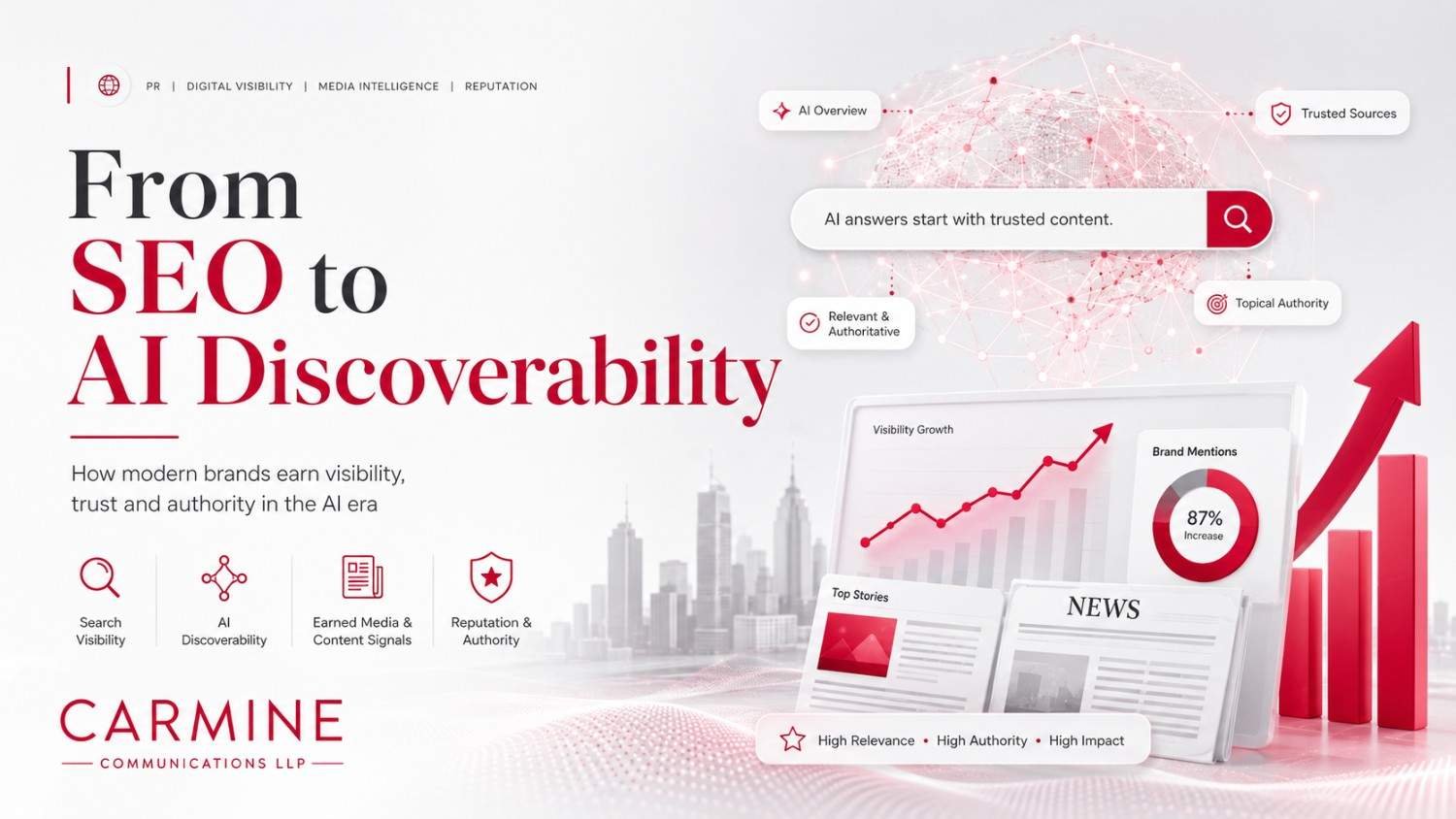
From SEO to AI Discoverability
Why earned authority is becoming the new search advantage
for Indian brands
For many years, digital
visibility was largely understood through the lens of SEO. Brands wanted to
rank on Google, appear for the right keywords, optimise their websites, publish
blogs and build backlinks. That discipline remains important. But the
information ecosystem is changing fast. Clients, investors, patients,
homebuyers, journalists, employees and other stakeholders are increasingly
asking AI tools direct questions and expecting direct answers.
This shift creates a new
challenge for reputation-led organisations: being searchable is no longer
enough. Brands must now become understandable, credible and quotable for AI
systems.
A user may not search for ten
blue links anymore. They may simply ask: Which are the trusted hospitals in
Mumbai? Which real estate developers are credible? Which PR agency understands
crisis communication? Which manufacturing company is reliable in India? Which
education institution has strong governance? The answer they receive may be
shaped by a much smaller set of sources than traditional search.
That is why AI discoverability
is becoming a reputation issue, not just a digital marketing issue.
What is AI-led SEO?
AI-led SEO is the practice of
shaping a brand’s digital and earned-media presence so that AI search engines,
chatbots and answer engines can understand, verify and accurately represent it.
Unlike traditional SEO, it is
not only about keywords, meta tags or backlinks. It depends on authority,
consistency, third-party validation and clarity of information across the web.
In practical terms, AI-led SEO
brings together corporate PR, digital PR, thought leadership, media
intelligence, content strategy, spokesperson visibility, structured data and
reputation management.
Why PR now matters more in AI search
AI systems prefer information
that appears credible, repeated across trusted sources and supported by
evidence. A brand’s own website is important, but self-published claims are not
enough. Earned media, expert quotes, high-quality interviews, explainers,
sector commentary, awards, institutional profiles and credible references all
help shape how a brand is interpreted.
This gives PR a renewed
strategic role. The purpose of PR is no longer limited to securing coverage. PR
must build a trusted information ecosystem around the organisation.
For Carmine, this is a natural
extension of reputation advisory. The agency’s role is to help clients earn
visibility in mainstream media, stakeholder conversations and AI-generated
answers.
What Indian brands should worry about
First, many organisations are
absent from AI-generated answers even when they have strong real-world
credentials. This happens when their digital footprint is thin, outdated or
poorly structured.
Second, AI tools may describe
brands using old information. Leadership changes, new projects, expanded
services, regulatory updates and recent achievements may not be reflected
accurately.
Third, competitors with stronger
content and earned-media visibility may dominate AI answers, even if they are
not stronger in business performance.
Fourth, negative or incomplete
narratives can travel faster when AI systems summarise public information
without context.
Where corporate PR and digital PR must converge
In the AI era, every major
communications activity should strengthen the brand’s discoverability and
credibility. A media interaction should create an authoritative third-party
reference. A leadership article should clarify sector expertise. A case study
should give AI systems proof of capability. A crisis response should ensure the
correct version of events is visible, structured and accessible.
This means communications teams
can no longer work in silos. Corporate PR, SEO, social media, website content,
reputation monitoring and spokesperson visibility must follow one integrated
narrative architecture.
A practical AI discoverability checklist
·
Audit how the brand appears across ChatGPT,
Gemini, Perplexity and other AI answer engines for 25 to 30 high-intent
questions.
·
Check whether the brand, leadership and services
are described accurately.
·
Identify which competitors are being recommended
more frequently.
·
Study which sources AI tools appear to rely on while
forming answers.
·
Strengthen the brand website with clear service
pages, leadership bios, case studies and FAQs.
·
Build earned authority through interviews,
expert articles, sector commentary and credible third-party mentions.
·
Monitor misinformation, outdated data and
negative narratives that may influence AI-generated responses.
The Carmine view: trusted visibility is the future
The next phase of PR will be
defined by trusted visibility. Brands will need to be visible in the right
places, represented accurately and supported by credible proof. This is
especially important in sectors where reputation directly influences trust:
healthcare, real estate, manufacturing, education, infrastructure, finance and
professional services.
For healthcare clients, AI discoverability
can influence how patients and families understand institutional credibility.
For real estate clients, it can shape buyer confidence. For manufacturing and
B2B clients, it can support investor, partner and buyer trust. For education
institutions, it can affect admissions, stakeholder confidence and crisis
resilience.
Carmine Communications believes
modern PR must protect and build reputation across the full information
ecosystem - media, stakeholders, search, social platforms and AI answers. This
requires intelligence, speed, editorial judgement, digital fluency and crisis
preparedness.
AI-led SEO is not a replacement
for PR. It is proof that credible PR is becoming even more valuable.
The brands that win in this
environment will not be those that publish the most content. They will be the
ones that are trusted, cited, understood and recommended.