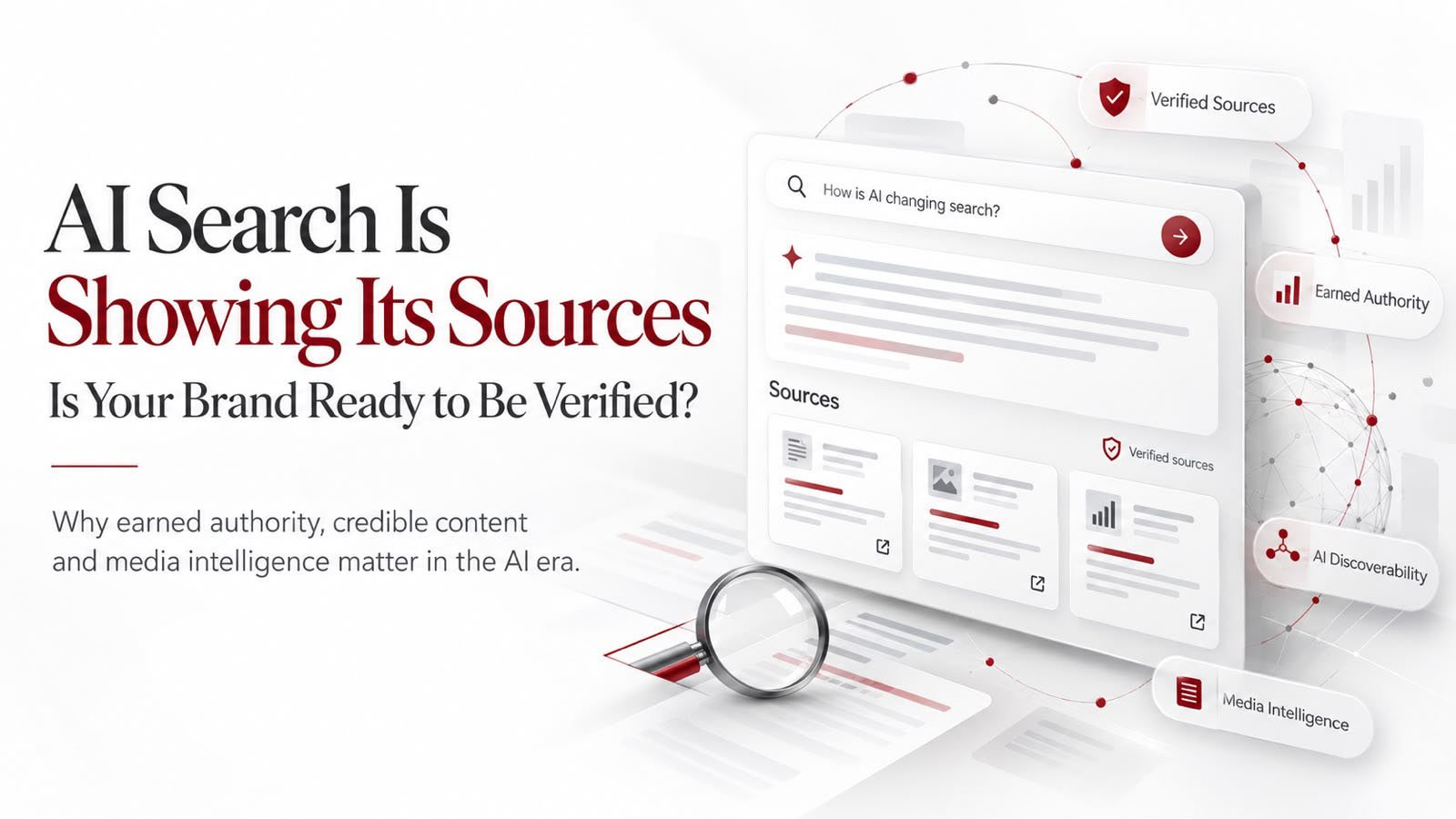
AI Search Is Showing Its Sources. Is Your Brand Ready to Be Verified?
As AI answers become more source-led, Indian companies need more than search-friendly copy. They need a clear, current and credible public record.
There is an important shift taking place in AI-powered search: the answer is becoming more useful, but the sources behind that answer are also becoming easier to inspect. For businesses, this means a company’s reputation may increasingly be judged not just by what an AI system says, but by what a customer can click to verify.
On 15 October 2026, Google announced
changes to AI Mode and AI Overviews, including more prominent inline links,
tests of dedicated links to official websites, and wider exposure for timely
journalism. On the same day, Google said more than 400 publications worldwide
were participating in its News AI pilot, which includes attribution and links
to original reporting. These are platform announcements, not a promise of
traffic or citation placement for any individual brand.
The direction, however, is relevant for
India. Boston Consulting Group’s September 2026 research found that
large-language-model search features in 22% of purchase journeys across the
Indian consumers it studied. Brands are increasingly encountered, compared and
evaluated within conversational information experiences.
The visibility question is changing
Conventional SEO asks whether a company’s
website is discoverable for the right searches. AI discoverability adds a
second test: when an AI system explains a category, recommends a solution or
summarises a company, does it represent the brand accurately—and can a reader
verify the underlying facts?
This distinction matters because AI
responses can compress many pieces of information into a short answer. A
polished claim on a company website may compete with a regulatory record, a
published interview, a customer experience, an industry study or an older news
report. Communications teams need to pay attention to the public evidence
surrounding the organisation, not just the words on the homepage.
Five signals that make a brand easier to understand and
verify
1. A clear and consistent corporate identity
Start with the basics: the same
organisation name, business description, leadership details, office locations
and services should appear consistently on the corporate website, official
profiles and relevant industry records. For complex groups, subsidiaries and
renamed businesses, explain relationships plainly. A search system cannot be
expected to clarify distinctions the company has never documented clearly
itself.
2. Evidence behind important claims
Replace abstract descriptions with facts
that can be checked. A manufacturer might document certified capabilities,
export destinations and production milestones; a real-estate developer might
provide project registration details, construction progress and possession
milestones; a hospital should support service and technology claims with
appropriate clinical context, qualified expertise and patient safeguards.
Evidence does not mean publishing
confidential information. It means making accurate, approved proof points
accessible, dated and attributable.
3. Earned credibility beyond the corporate website
Independent reporting, specialist
interviews, industry research and substantive executive commentary create
additional context around a company. They can help stakeholders distinguish a
claim made by a business from an assessment supported by external reporting.
Earned coverage does not guarantee AI citation; it strengthens the accessible
information environment that people and search systems may consult.
4. Spokespeople known for something specific
A leadership profile is stronger when the
individual is associated with a clear field of expertise rather than occasional
ceremonial quotes. CEOs can speak about market direction, CFOs about financial
resilience, medical leaders about clinical standards, and technical executives
about product safety or manufacturing capability. Consistent, evidence-based
thought leadership gives journalists and stakeholders a reason to return to
them.
5. A system for checking the answers themselves
Media monitoring traditionally tracks
coverage and sentiment. A modern reputation programme should also test priority
AI queries: what is said about the organisation, who is compared with it, which
sources are shown, and whether incorrect or outdated statements recur. Since
answers can vary by platform, user context and time, this is a directional
monitoring exercise—not a single universal “AI ranking”.
What this means in five high-trust sectors
Healthcare: ensure medical claims,
credentials, safety information and clinical responsibilities are unambiguous.
Real estate: keep regulatory and project information current and accessible.
Manufacturing and B2B: publish verifiable capability and operating evidence,
not only product brochures. Education: be specific about institutional
policies, grievance processes and student safeguards. Corporate and financial
services: maintain accurate governance, leadership and corporate-structure
information, supported by credible spokespersons.
In each sector, an AI answer may be the
first introduction. The official website and credible third-party record must
withstand the second look.
A practical 30–60–90 day roadmap
Days
1–30 — Audit the evidence. Select 25 high-value
questions that potential clients, journalists, investors or stakeholders might
ask. Record answer accuracy, missing information, competitor presence and
citations. Check whether official web pages reflect current facts.
Days
31–60 — Build missing authority. Prioritise a
factual services page, clear leadership biographies, dated expert explainers,
sector-specific evidence pages and an editorial calendar for relevant
earned-media insight. Correct inconsistent public information where possible.
Days
61–90 — Connect PR to measurement. Track recurring
questions each month; compare changes in source visibility, accuracy and
qualified referral traffic, while also monitoring media quality, executive
authority, organic search and business enquiries.
The Carmine perspective: from publicity to public evidence
At Carmine Communications, we believe the
next generation of PR must connect reputation counsel with the way people and
AI systems discover information. The task is not to produce more generic
content, nor to promise placement in an AI response. It is to help businesses
build a coherent and credible public record—through strategic narratives,
authentic leadership voices, earned media, responsive digital channels, crisis
readiness and intelligent monitoring.
Technology can make information easier to
find. It is the organisation’s conduct, clarity and evidence that make it worth
trusting.
Frequently asked questions
What
is AI discoverability for a company?
It is the extent to which a business is
accurately found, described and, where relevant, cited or included in
AI-generated answers to important audience questions.
Does
earned media guarantee that ChatGPT or Google AI will mention a brand?
No. Coverage may contribute to the broader
public information environment, but no PR agency can guarantee inclusion, a
ranking or a citation in an independent AI answer.
How
is AI discoverability different from SEO?
SEO improves search access and performance.
AI discoverability additionally examines how an organisation is interpreted and
represented inside conversational answers and what sources support that
representation.
What
should businesses measure first?
Begin with answer accuracy, source
visibility, competitive comparisons, official-information consistency and the
quality of incoming enquiries, rather than relying on a single AI score.